



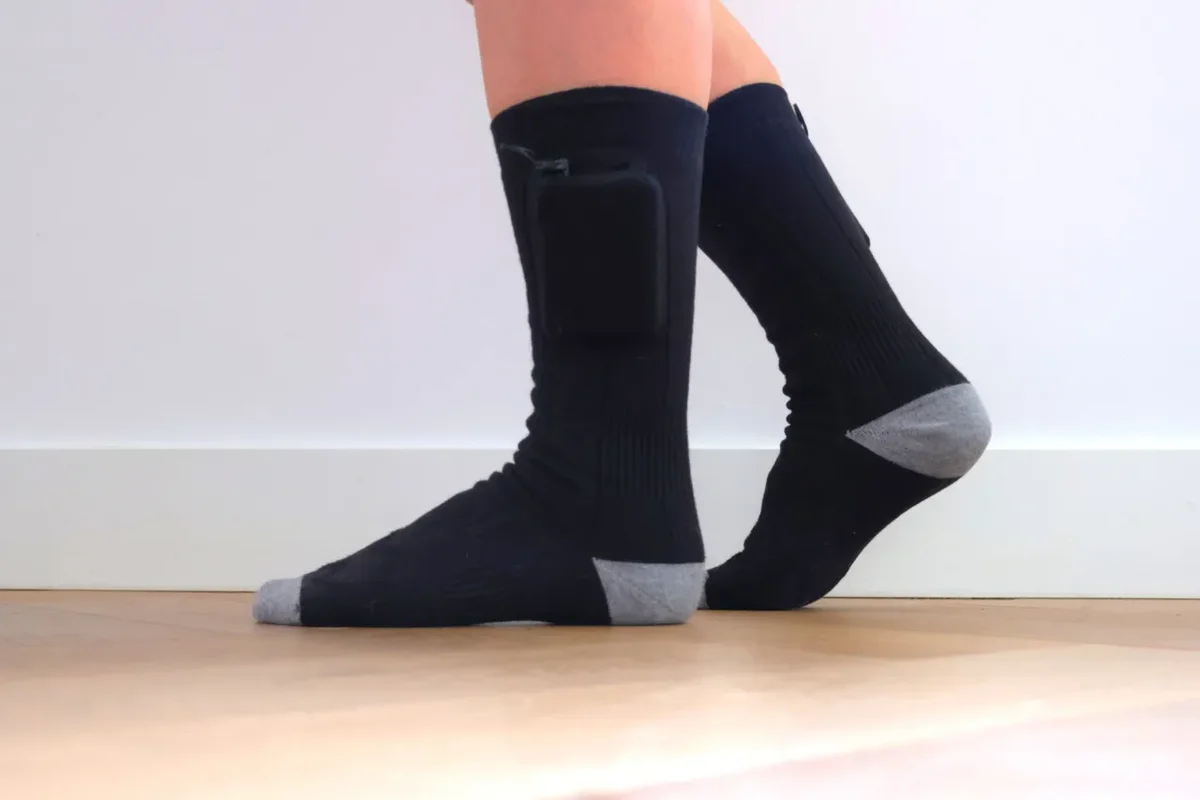
You mainly want warm feet to actually stay comfortable in your shoes. That immediately leads to the key choice: do you want heat you feel right at your toes, or a more even warmth that gently keeps your whole foot at temperature? If you browse heated socks, you’ll see many models are built around exactly those two approaches.
What you notice in real life: the heat distribution determines how it “hits.” Toe/forefoot warmth often feels quicker and more obvious, like a warm spot. Even heat usually feels more subtle, but it can feel steadier during longer periods outdoors.
Toe warmth: nice if your toes are the first to give up
With toe warmth, the heating zone sits at your toes or forefoot. That’s especially helpful if you notice your toes always get cold first. You get a noticeable warm feeling in that area quickly, without your whole foot needing to warm up right away.
Inside your shoe, this works best if the sock stays in place and the heating zone really sits at the front. Especially in tight shoes (like a tight ski boot), you don’t want folds, edges, or anything that starts to press. Heat isn’t the issue then—fit-related irritation is.
Also keep in mind this can feel deliberately local: your toes get warm while your instep and heel stay relatively cooler. If you find that unpleasant and want the same feeling everywhere, a more spread-out heat distribution often fits better.
When something else makes more sense: if it’s not just cold toes, but you notice your whole foot cooling down, then even heat usually gives a calmer overall feel.
Even heat: calmer feel, less of a start boost
Socks with even heat distribution build warmth more spread out. Instead of one clear “hotspot,” you get a constant, gentle warmth that supports your whole foot. That can be comfortable on longer days outside (for example hiking, working outdoors, or skiing with lots of lifts and queueing), because the comfort often stays stable.
Good to know: this often feels less “instantly warm.” Because the heat doesn’t peak in one spot, you might not notice it on a low setting until after a while. And the same applies here: in very tight shoes the sock can still produce heat, but it usually feels better if your foot has enough room. With a bit of space, warmth is easier to retain without it quickly feeling stuffy or too hot.
Thickness, fit, and moisture: this is where it often goes wrong
The sock can deliver heat, but your shoe comfort determines whether that heat stays pleasant. If your sock fits well and feels less clammy, the warm feeling usually stays “stable” for longer.
So run through these 5 checks: your toes can still move, you don’t feel pressure points at the toe area, the fabric stays smooth without folds, the sock doesn’t feel spongy after an hour, and seams aren’t irritating around your toes. If that’s all good, the warmth comes into its own—whatever distribution you choose.
When are you better off skipping heated socks?
Sometimes what you’re missing isn’t so much warmth, but dryness or space. If your feet get cold because of clamminess or wet socks, extra heat doesn’t always solve that. In that case, a dry, well-fitting sock often brings comfort faster.
And if your shoes already feel tight, extra sock thickness (heated or not) can actually work against you. Then it often helps more to first get your shoe space and pressure distribution sorted. With enough room at the forefoot and toes, the warmth your sock provides feels noticeably more comfortable—whichever heat distribution you choose.
Not sure whether to choose toe warmth or even heat? Think about your cold moment: if your toes get cold first, targeted warmth often fits better; if your whole foot cools down, even heat usually makes more sense.

